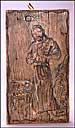
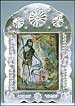
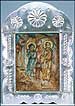
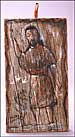
 Well-known
for his exquisite straw appliquéd art, what is not commonly known is that
Eliseo Rodríguez started his artistic career as a formally trained painter.
In his words "I was the only Spanish (person) at the Santa Fe Art School."
In 1936 Rodríguez was hired to paint for the Federal Art Project (FAP),
doing oil on canvas landscapes, reverse paintings on glass, and a number of murals
that were exhibited locally and circulated nationally.
Well-known
for his exquisite straw appliquéd art, what is not commonly known is that
Eliseo Rodríguez started his artistic career as a formally trained painter.
In his words "I was the only Spanish (person) at the Santa Fe Art School."
In 1936 Rodríguez was hired to paint for the Federal Art Project (FAP),
doing oil on canvas landscapes, reverse paintings on glass, and a number of murals
that were exhibited locally and circulated nationally.
 Shortly after he was began work with the FAP, Rodríguez was encouraged
to try his skills at the art of straw appliqué. Along with his wife Paula,
Rodríguez studied colonial examples and re-developed this art form. While
their first pieces featured only geometric patterning, the Rodríguez's
expanded the art form to include narrative scenes. His painterly perspective and
strong compositional style translate beautifully into the finely positioned straw.
Shortly after he was began work with the FAP, Rodríguez was encouraged
to try his skills at the art of straw appliqué. Along with his wife Paula,
Rodríguez studied colonial examples and re-developed this art form. While
their first pieces featured only geometric patterning, the Rodríguez's
expanded the art form to include narrative scenes. His painterly perspective and
strong compositional style translate beautifully into the finely positioned straw.
Rodríguez
created other art forms for the WPA art projects. Although he was never properly
credited, Rodríguez, along with his wife Paula and fellow artist Louis
Ewing, was one of the first American artists to develop the silk-screen method
of serigraphy for book illustrations. Together they produced a portfolio of religious
imagery and another featuring southwestern weaving designs for the Laboratory
of Anthropology in Santa Fe.
Upon returning from his World War II tour
of duty, Rodríguez created furniture for Southwest Master Craftsmen and
taught wood arts at the Agua Fría Vocational School. During the 1960s he
was commissioned to do a large mural for Our Lady of Grace Church in Castro Valley,
California. In 1972 Rodríguez illustrated a small collection of Federal
Writer's Project stories titled Echoes of the Flute by Lorenzo de Córdova
(a.k.a. Lorin Brown). A past recipient of the New Mexico Governor's Award for
the Arts, he continues to paint and practice other art forms.
|