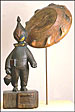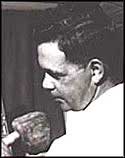
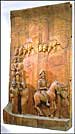
Born in Springer, New Mexico, Emilio Padilla sculpted from the time he could pick up a knife. He moved to Santa Fe as a child and, at the age of fourteen, trained at the Santa Fe art school as a painter and a muralist. Padilla worked with Eliseo Rodríguez both here and at the WPA's Federal Art Project (FAP) studio in Santa Fe. In January 1934, Padilla began work on a large relief sculpture for the Public Works of Art Project (PWAP). The work, a depiction of Don Diego de Vargas and his second occupation of New Mexico in 1695, was originally made for the Palace of the Governors building on Santa Fe's plaza, but then became part of an exhibit at the Coronado State Monument in Bernalillo, New Mexico. The sculpture is similar in composition to WPA post office murals painted across the country, which depicted the "American Scene" during the New Deal era. Padilla's artistic perspective and his formal training are evident in his placement of the carved figures of Vargas, priests, soldiers, and oxen. Padilla's son Nino restored and stabilized the sculpture in 1983. Records state that, like fellow artists Santiago Matta and Juan Amadeo Sánchez, Padilla created three-dimensional religious sculptures for the FAP. He also made hand-carved furniture and ironwork. Although he continued to sculpt throughout his lifetime, by 1954 he was working as a draftsman for the New Mexico State Highway Department in order to make a living. In addition to what is known about his multi-talented artistic background, fictionalized details of Emilio Padilla's life appear in a short story titled "Xavier's Folly" (University of New Mexico Press, 1973) by well-known southwestern writer and actor, Max Evans. |
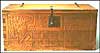 |
| Caja / Chest |

|
| Detail of Caja / Chest |
 |
|
|
| Aropeighertzipog con su Platillo Volador / Aropeighertzipog with his Flying Saucer |